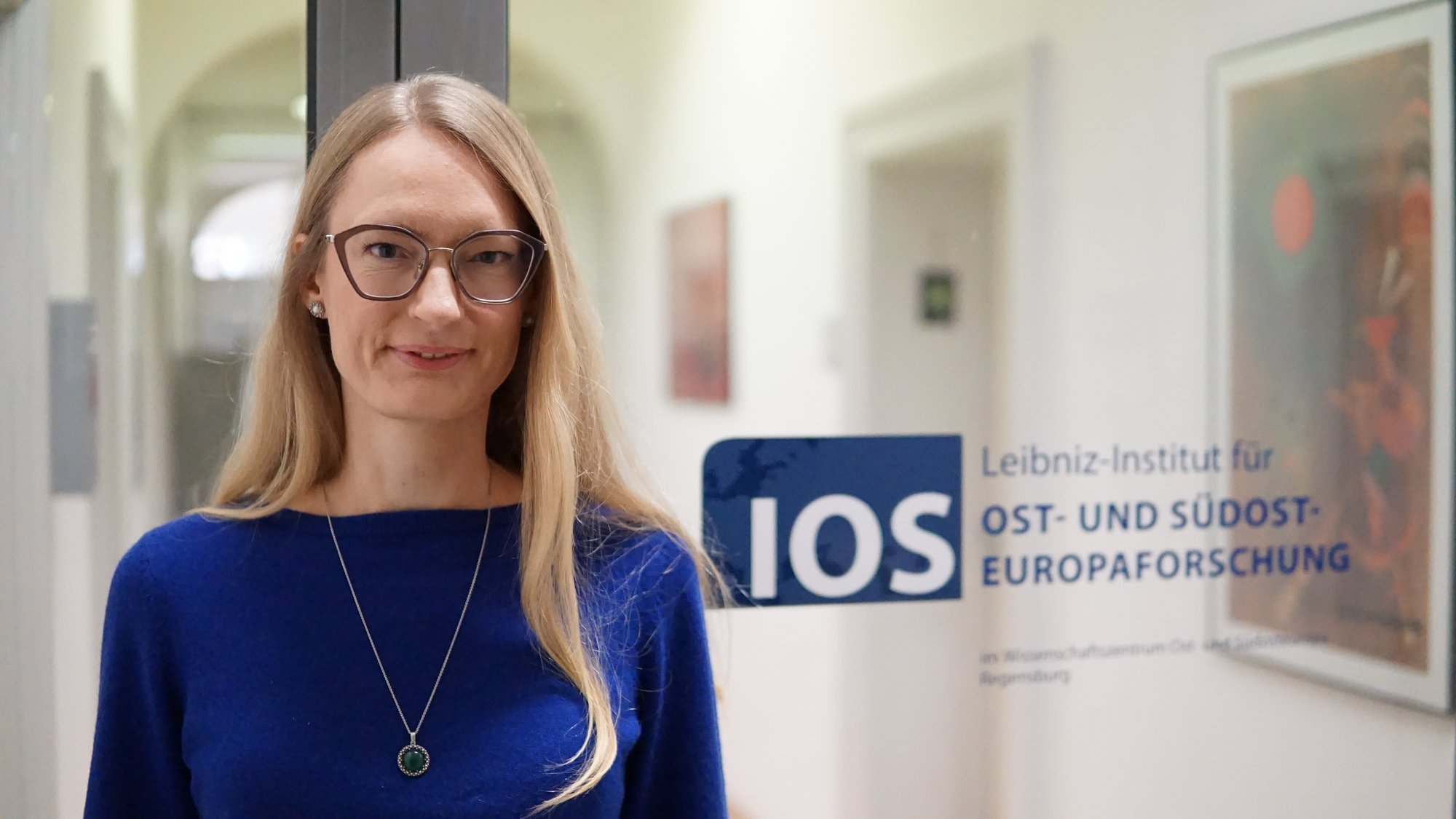
ERC Consolidator Grant für Volha Bartash
The European Research Council (ERC) has awarded Volha Bartash a Consolidator Grant for her Project “EMPOWER: Empowering Legacy. Sites of Romani Genocide and Community Commemoration in East and East-Central Europe”. The project, which will begin in 2026 at the IOS, will receive funding of around €2 million over five years.
Background:
During World War II, several hundred thousand Roma perished, primarily in East and East Central Europe (EECE). Yet, their experiences remain largely unknown to the broader public and are underrepresented in the landscapes of European memory. This omission stems from the silencing of Romani histories under state socialism, gaps in historical documentation, and postwar memory politics. These silences persist to this day. Many sites of the Romani genocide - mass killing sites, labour camps, and prisons - remain unmarked and urgently require preservation measures.
EMPOWER undertakes an ambitious effort to rediscover the forgotten memoryscapes of Roma in EECE. Unlike previous studies of neglected sites, which primarily focused on trauma, EMPOWER poses a critical question: Can such sites of painful memory become spaces of empowerment and solidarity? To answer this question, the project sheds light on how Roma families and communities have commemorated genocide sites and honoured their lost family members, from the postwar period to the present.
The project:
To reconstruct Romani memoryscapes, EMPOWER integrates oral history and ethnographic qualitative methods with archival research and digital humanities tools, such as GIS technology, mapping, and visualization. The in-depth case studies across EECE highlight the lives and legacies of Romani survivors and activists who have transformed neglected sites into spaces of memory.
EMPOWER takes a community-centred approach to understanding the legacy of these neglected sites. The project actively engages Roma communities in both data collection and dissemination. Alongside scholarly publications, its deliverables include the online platform, Hidden Sites, Living Voices, that will feature interactive maps, activist biographies, and historical documents in English and vernacular languages, including Romani. These tools are designed to ensure the project’s findings are widely accessible.
Besides the Principal Investigator, there will be three post-doc positions created at the Institute as part of the project, each with a regional focus: one on Poland, one on Czechia and Slovakia, and one on Hungary.
About Volha Bartash:
Volha Bartash is a historian and social anthropologist specializing in Eastern Europe, whose work illuminates the experiences and memories of vulnerable and marginalized communities. She has held research and teaching positions at the University of Münster and at the Graduate School for East and Southeast European Studies in Regensburg, and received a prestigious Marie Skłodowska-Curie Fellowship for her groundbreaking study of Roma memory in Belarus and Lithuania, conducted at the IOS. Bartash has written extensively on the history and memory of the Nazi genocide of Roma. Methodologically, she combines archival inquiry, oral history, and ethnography, maintaining a strong commitment to writing history “from below.” Bartash has held fellowships at the United States Holocaust Memorial Museum, the Helsinki Collegium for Advanced Studies, the Vienna Wiesenthal Institute, and the Imre Kertész Kolleg Jena. Most recently, she was honored with the Vilis Vītols Prize from the Association for the Advancement of Baltic Studies (2024).
ERC Consolidator Grants:
The ERC Consolidator Grant is one of Europe’s most prestigious awards for mid-career researchers, supporting ambitious frontier research. It provides up to roughly € 2 million for high-risk, high-reward projects, with a recent success rate of about 11.2%.