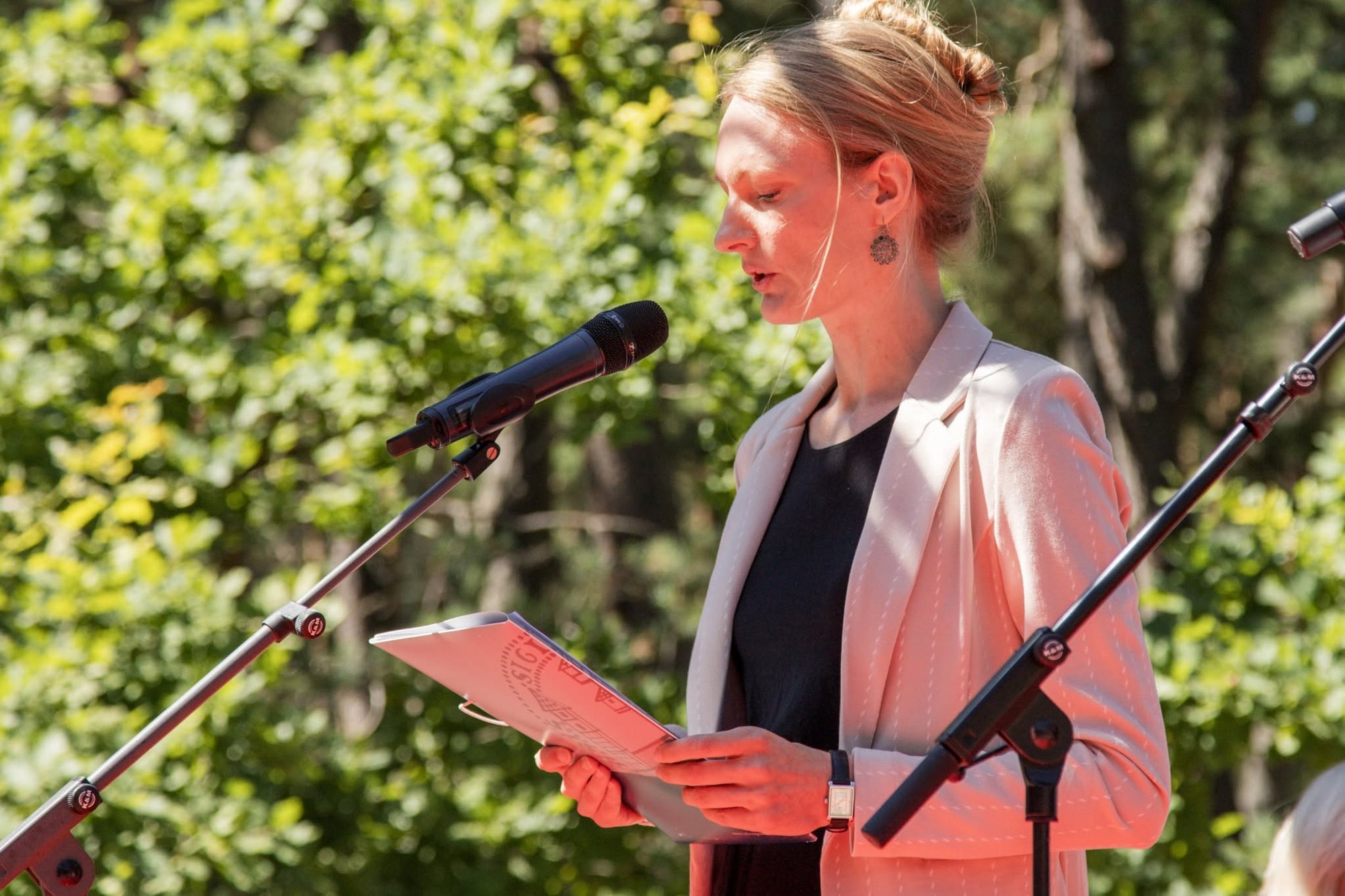
Volha Bartash spricht bei Litauens nationaler Gedenkfeier zum Europäischen Holocaust-Gedenktag für Sinti und Roma
IOS researcher Volha Bartash delivered a speech at Lithuania’s national commemoration of European Roma Holocaust Memorial Day in the Paneriai Memorial Forest near Vilnius. Bartash, a historian and social anthropologist, is the Principal Investigator of the ERC Consolidator project EMPOWER, based at the IOS. The project aims to rediscover forgotten Romani genocide memoryscapes in East and East-Central Europe.
Paneriai is the largest mass killing site in Lithuania and one of the largest in Eastern Europe. From 1941 to 1944, German occupying forces and local collaborators murdered tens of thousands of people there, including Jews, Roma, Poles, and Soviet prisoners of war. At least 138 Roma victims have been documented.
A "Path of Memory"
The commemoration on August 3, 2026, brought together representatives of Lithuanian state institutions, diplomatic missions, academia, educators, and the Roma community. The event began with the symbolic "Path of Memory" procession from the Paneriai railway station to the memorial site. Participants honored the victims by singing the Roma anthem, observing a minute of silence, and laying flowers.
Since 2003, the Roma Community Center, led by Svetlana Novopolskaja, has organized commemorative events at Paneriai, creating a tradition of remembrance and drawing attention to the Roma genocide, which was neglected for decades.
In her speech, Volha Bartash recalled her first visit to Paneriai in 2016, when the memory of the Roma victims was barely visible apart from a symbolic stone wheel created by schoolchildren and teachers. Bartash reflected on the changes that have occurred since then, which were achieved through the efforts of Lithuanian researchers, public institutions, and most importantly, the Roma community itself. She highlighted Paneriai’s potential to become a site of European memory and a space for encounter, dialogue, and learning.
"Signs of a healthy democracy”
Volha Bartash emphasized that memory does not preserve itself—it is sustained by people who ask questions, collect testimonies, care for places of memory, and pass these histories on to future generations. She stressed that remembrance is not only about asking what happened, but also how it became possible. As Bartash noted, “The willingness to ask such questions is one of the signs of a healthy democracy.”
Following the commemoration, Volha Bartash took part in a public conference at the Vilna Gaon Museum of Jewish History. There, scholars, heritage specialists, and Roma community representatives discussed their vision for a memorial to the Roma genocide at Paneriai.
Bartash presented the EU-funded project EMPOWER: Empowering Legacy: Sites of Romani Genocide and Community Commemoration in Eastern and East-Central Europe". Together with her team, Bartash will study sites such as Paneriai in seven Eastern and East-Central European countries, including Lithuania. The Lithuanian partner of the project is Neringa Latvyte, an assistant professor at Vilnius University. EMPOWER collaborates with her on research, documentation, and public engagement related to the history and memory of Roma persecution in Lithuania.