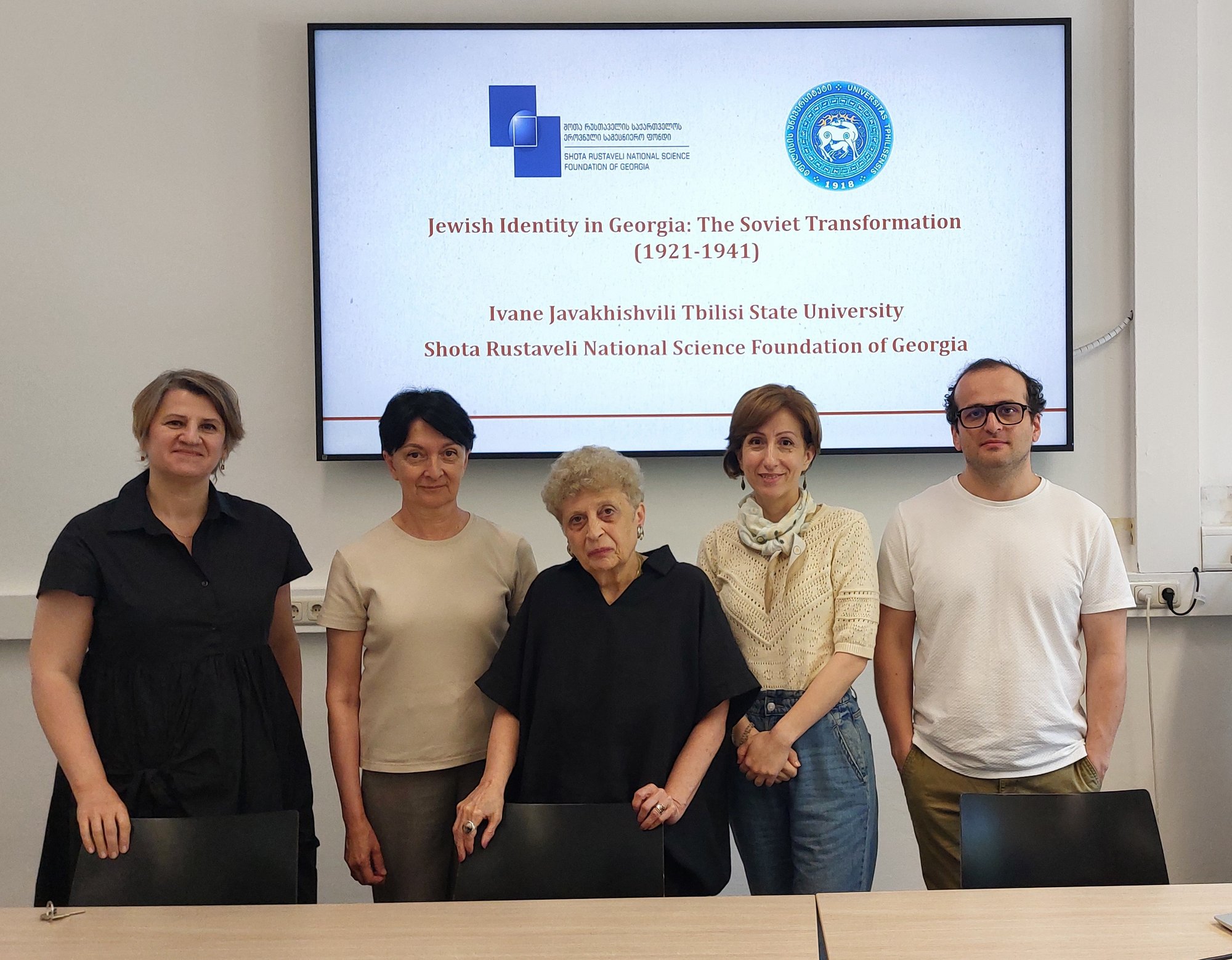
Jewish Identity in Interwar Soviet Georgia Discussed at IOS
On 18–19 June 2026, a group of scholars from Georgia visited the IOS as part of the collective research project "Jewish Identity in Georgia: The Soviet Transformation (1921–1941)." Supported by the Shota Rustaveli Georgian National Science Foundation (FR-23-8490), the project is led by Dr. Ketevan Kakitelashvili, Associate Professor at Ivane Javakhishvili Tbilisi State University. The visit was organized by Dr. Svetlana Suveica (IOS), who serves as the external scientific advisor to the project.
The visit provided an opportunity to discuss ongoing research and strengthen academic cooperation between Georgian and German scholars. Project members presented their work in progress on a range of topics, including Constructing Socialist Jewish Identity: National and Economic Experiments in Early Soviet Georgia (1920s–1930s) (Prof. Dr. Nino Chikovani, Ivane Javakhishvili Tbilisi State University), Georgian-Language Jewish Literary Works as a Reflection of the Soviet Transformation of Cultural Life in Georgia in the 1920s and 1930s (Prof. Dr. Nino Pirtskhalava, Ilia State University), and The Rupture of Lived Space: The Transformation of Georgian Jewish Identity and the Urban Fabric of the “Jewish Street” (1920s–1930s) (Michael Meparishvili, PhD Candidate, Ivane Javakhishvili Tbilisi State University).
As part of the Research Colloquium "History and Social Anthropology of Southeastern and Eastern Europe," Dr. Ketevan Kakitelashvili presented preliminary findings from the project. Her presentation sparked a lively discussion with researchers from IOS and the University of Regensburg on the transformation of Jewish identity under the first period oft he Soviet rule and its broader regional implications.
The visit offered valuable insights into current scholarship on Georgia and the South Caucasus. It also provided an opportunity to discuss methodological challenges and explore comparative perspectives on questions of identity, minority policies, urban transformation, and Soviet modernization, while serving as a platform for identifying future avenues of collaboration. The project team was encouraged to disseminate its findings through IOS publication outlets and other international academic journals.
During their stay, the Georgian scholars also learned more about IOS, its ongoing research activities related to the Caucasus, and its extensive library and archival resources. Particular interest was devoted to the institute’s holdings on Georgia, including the digitized German-language newspaper Kaukasische Post: die deutsche Monatszeitung aus dem Südkaukasus (Tbilisi, 1906–1914), the only newspaper in German language in the region, which is an important source for the study of its social and cultural history.